Presentation anxiety is a preparation problem, not a confidence problem
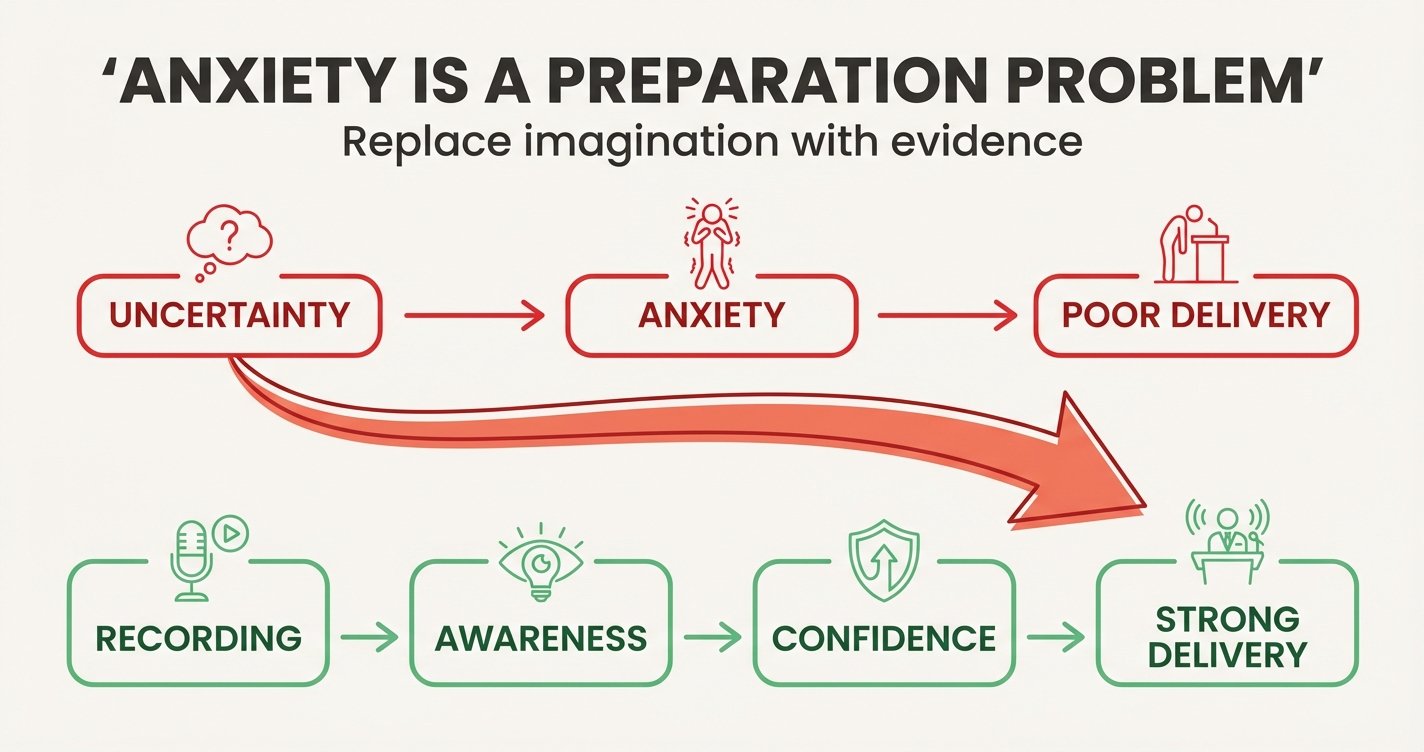
You have a board meeting in 48 hours. Your deck is ready. But your stomach is already tight. You'll sleep badly tonight. You'll over-caffeinate tomorrow. You'll speed-talk through slide 6 and regret it before you finish.
Everyone calls this "presentation anxiety." The advice is always the same: breathe deeply, visualize success, power pose in the bathroom.
That advice treats the symptom. The root cause is simpler: you don't know what you look like when you present, so you fill the uncertainty with dread.
The uncertainty loop
Anxiety comes from uncertain outcomes. You don't know if you'll stumble on the revenue slide. You don't know if your pacing will be off. You don't know if your nervous tics will show. You've never seen yourself from the audience's perspective, so you imagine the worst.
If you'd watched yourself present 10 times, you'd know exactly what happens. You'd know your pace hits 180 WPM on slide 3. You'd know you say "you know" during transitions. You'd know your energy dips at minute 7.
That knowledge replaces anxiety with a checklist. "I need to slow down on slide 3" is actionable. "I'm terrified of this presentation" is not.
Preparation that actually reduces anxiety
Most people prepare by reviewing their slides. That's content preparation. It's necessary but insufficient. What reduces anxiety is delivery preparation — knowing how your body and voice will behave under pressure.
Step 1: Record a full run-through. Not in your head. Out loud, standing up, as if it's real. Full volume. Timed.
Step 2: Watch it. The first time is painful. By the third recording, it's just data. You'll see patterns, not panic.
Step 3: Fix two things. Not everything. Two specific things. "I'll pause after the revenue number instead of rushing" and "I'll make eye contact during the closing."
Step 4: Record again. See the improvement. That visual proof — watching yourself get better — is the most powerful anxiety reducer that exists.
Why "just be confident" is terrible advice
Confidence isn't a switch you flip. It's the byproduct of specific preparation. You're confident in the parts of your presentation you've practiced. You're anxious about the parts you haven't.
Notice the pattern: the sections that make you most nervous are the sections you've rehearsed least. The competitive slide you're not sure about. The pricing justification you haven't practiced out loud. The Q&A you can't predict.
The fix isn't confidence. It's rehearsal — specifically, rehearsal of the parts that scare you.
The pre-meeting protocol
48 hours before any important presentation:
- Record a full run. Watch it. Identify the 2 weakest minutes.
- Practice only those 2 minutes. Five times. Until they feel automatic.
- Record a second full run. Compare. See the improvement.
- Night before: review your opening and closing only. These are your bookends. Nail them and the middle takes care of itself.
Morning of: no more practice. You're prepared. The recording proved it. Your anxiety drops because it's no longer based on uncertainty — it's based on evidence.
The data on this
People who record and review their presentations before important meetings report 40-60% lower anxiety scores than those who only rehearse mentally. The mechanism is simple: watching yourself replaces imagination with reality. And reality, it turns out, is usually better than what you imagined.
Your presentation anxiety isn't about confidence. It's about certainty. Get certain about your delivery — by watching it — and the anxiety handles itself.
More in Presentation Rehearsal
How to Rehearse a Presentation by Yourself: A 7-Step System That Actually Works
Practicing a presentation alone does work if you follow a repeatable system. Use this 7-step solo rehearsal workflow to improve pacing, confidence, and clarity before a high-stakes talk.
Presentation Rehearsal Checklist: 17 Things to Fix Before a Big Meeting
Use this presentation rehearsal checklist before an investor pitch, sales demo, thesis defense, or board update. It covers pacing, slide transitions, clarity, timing, and delivery.
How Many Times Should You Rehearse a Presentation? A Better Rule Than 'Until It Feels Good'
Most presenters ask how many times they should rehearse a presentation. The better answer depends on talk length, stakes, and whether your last run actually improved.
See yourself the way your audience sees you
Upload a presentation recording. Get AI coaching on delivery, slides, narrative, and audience reactions.
Try free preview