Record yourself presenting. The 15 minutes that will change how you communicate.
Every professional athlete watches game tape. Every musician records practice sessions. Every actor watches dailies. But most professionals who present weekly have never once watched themselves present.
This is the single biggest untapped improvement lever in business communication.
Why you resist it
You already know you should record yourself. You've known for years. You haven't done it because watching yourself is painful. Your voice sounds weird. Your face does things you didn't authorize. You see every flaw with 10x magnification.
That discomfort is the point. It's the gap between how you think you look and how you actually look. Closing that gap is how you improve.
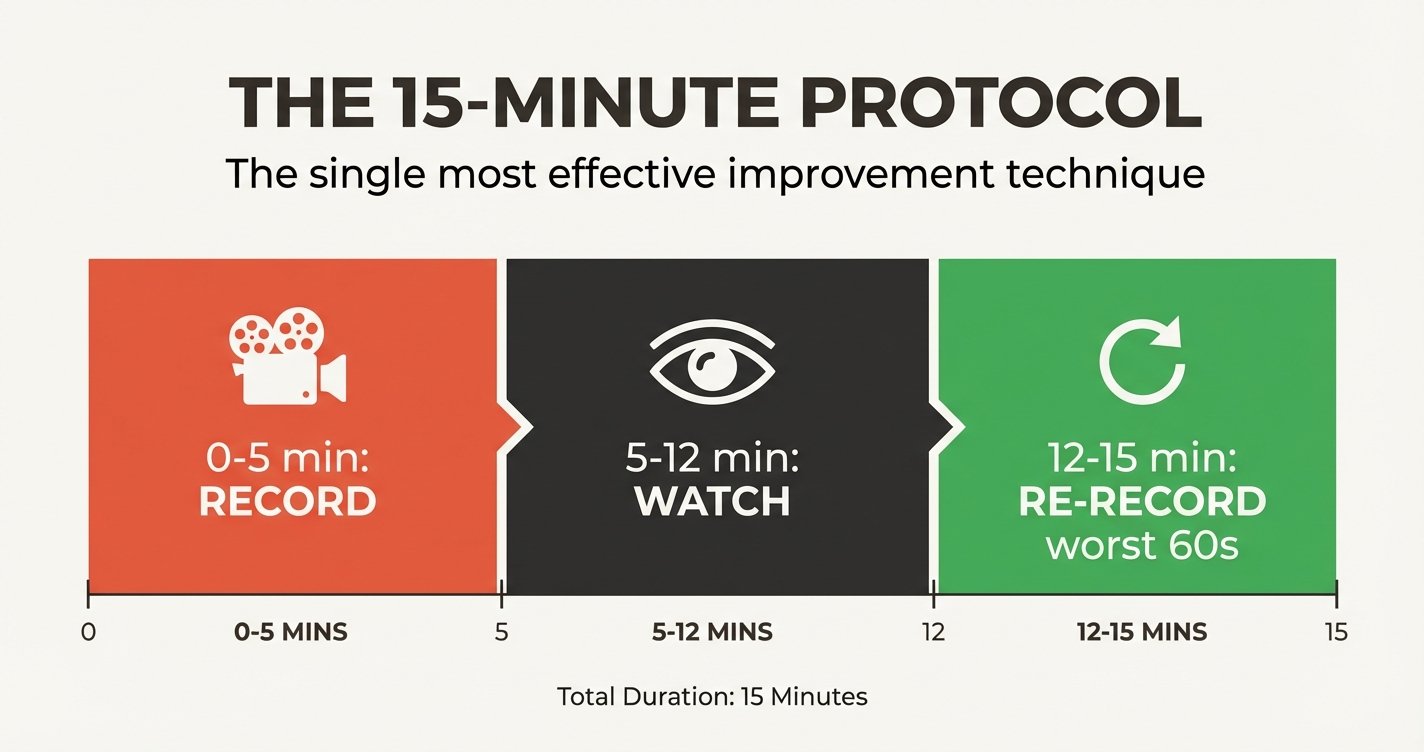
The 15-minute protocol
Minutes 1-5: Record.
Set up your phone against a water bottle. Open your most recent presentation. Present the first 5 minutes as if you're in the meeting. Standing up. Normal volume. Don't redo takes.
Minutes 5-12: Watch.
Play it back. No sound first — just watch your body for 60 seconds. Then watch with sound. Take notes on:
- The first thing that bothers you (this is your #1 fix)
- Any moment you looked away from the camera for more than 3 seconds
- Any moment you sped up noticeably
- Your posture at minute 1 vs minute 4
Minutes 12-15: Re-record the worst 60 seconds.
Find the worst minute from your first recording. Record just that minute again. Apply the one fix you identified. Compare.
That's it. Fifteen minutes. You'll learn more about your presentation style than a year of "great job" feedback from colleagues.
What to look for
In order of impact:
1. Where do your eyes go? If you're looking at slides more than the camera/audience, those slides have too many words. This is the #1 presentation problem and the easiest to fix.
2. What's your resting face? Between sentences, when you're transitioning — what does your face do? Most people go blank. That reads as bored or disengaged.
3. How do you start sentences? "So..." "Basically..." "Um..." The first word of each sentence reveals your filler word pattern.
4. What do your hands do? Are they helping (gesturing to emphasize) or hurting (fidgeting, touching your face)?
5. Where do you speed up? These are the sections you're least confident about. They need more practice, not less.
The compound effect
Recording yourself once is useful. Recording yourself regularly is transformative.
Do it once a week for a month. Track three metrics:
- Filler word count per minute
- Eye contact breaks (count them)
- Your subjective energy rating (1-10)
By week 4, most people improve all three metrics by 30-50%. Not because they learned something new. Because they became aware of something old.
The technology gap
Until recently, "watch your recording" meant staring at a video and trying to notice everything at once. You'd catch the obvious things (I said "um" a lot) and miss the subtle ones (my pace drops by 20% every time I transition to a data slide).
AI presentation analysis changes this. It watches the video the way a coach would — tracking every filler word, measuring pace changes, flagging eye contact breaks, mapping energy across time. You get a timestamped report of every moment that matters, not just the ones you happened to notice.
But the starting point is the same: hit record.
More in Presentation Rehearsal
How Many Times Should You Rehearse a Presentation? A Better Rule Than 'Until It Feels Good'
Most presenters ask how many times they should rehearse a presentation. The better answer depends on talk length, stakes, and whether your last run actually improved.
How to Rehearse a Presentation by Yourself: A 7-Step System That Actually Works
Practicing a presentation alone does work if you follow a repeatable system. Use this 7-step solo rehearsal workflow to improve pacing, confidence, and clarity before a high-stakes talk.
Presentation Rehearsal Checklist: 17 Things to Fix Before a Big Meeting
Use this presentation rehearsal checklist before an investor pitch, sales demo, thesis defense, or board update. It covers pacing, slide transitions, clarity, timing, and delivery.
See yourself the way your audience sees you
Upload a presentation recording. Get AI coaching on delivery, slides, narrative, and audience reactions.
Try free preview