Your body language on camera is telling a different story than your words
In person, your audience sees you from 10 feet away. On camera, they see you from 18 inches. Every fidget, every glance away, every slouch is magnified.
Most people have never watched themselves present on camera. When they do, the reaction is always the same: "I had no idea I did that."
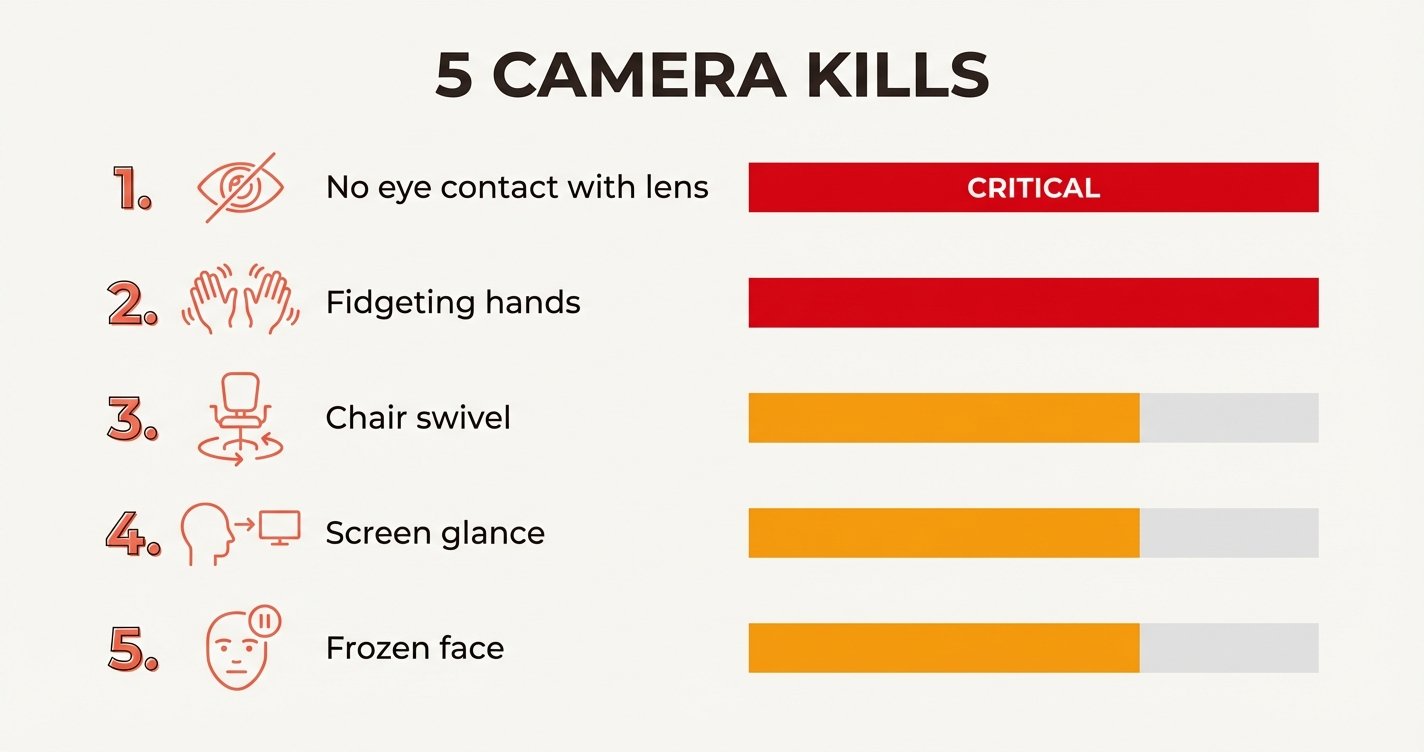
The 5 camera kills
These are the body language habits that destroy your credibility on video, ranked by how much they hurt:
1. No eye contact with the lens. You're looking at the screen, at your notes, at yourself in the preview window. Everywhere except the camera. To your audience, you're avoiding eye contact. Fix: put a sticky dot next to your camera. Look at the dot.
2. Fidgeting hands. Clicking a pen, touching your face, adjusting your hair, playing with a ring. On camera, your hands are in frame and every movement draws attention away from your words. Fix: hands on the desk or deliberate gestures. Nothing in between.
3. The chair swivel. Rocking side to side in your chair. You don't notice it. Your audience can't stop noticing it. Fix: lock your chair or stand.
4. The screen glance. Looking at your second monitor, checking Slack, reading your notes off screen. Your eyes move off-camera and the audience sees it instantly. Fix: close everything except your presentation. One screen.
5. The frozen face. No expression. No nodding. No smiling. Just a blank stare while you talk. This reads as disengaged or robotic. Fix: slightly exaggerate your expressions for camera. What feels over-the-top to you looks normal on screen.
Why camera is harder than stage
On stage, you can move. You can use your whole body. Your audience is far enough away that small movements don't register.
On camera, you're in a box. A small rectangle. Your face and upper body are all you have. Every micro-movement is visible. The presentation becomes about your face, not your slides.
This is why so many people who are great in-person presenters struggle on video. The skills don't transfer directly. Camera is its own medium with its own rules.
The 2-minute mirror test
Record yourself talking for 2 minutes about anything. Watch it with the sound off.
Just watch your body. What do you see? That's what your audience sees. They're processing your visual signals before your words even register.
If you look confident with the sound off, you'll sound confident with the sound on. If you look nervous with the sound off, no amount of vocal coaching will override that visual signal.
What AI catches
Modern AI presentation tools analyze your video feed frame by frame. They can detect:
- Eye contact percentage over time
- Posture shifts (leaning back = disengagement, leaning forward = intensity)
- Gesture frequency (too few = stiff, too many = anxious)
- Facial expression range (flat vs. dynamic)
- Fidget patterns and their timestamps
The value isn't in the metrics themselves. It's in the timestamps. "At 3:45 you broke eye contact for 8 seconds" is actionable. "Improve your eye contact" is not.
More in Delivery And Presence
Presentation Body Language Mistakes: 9 Habits That Quietly Undermine Credibility
Presentation body language mistakes are often subtle: disappearing eye contact, collapsed posture, nervous fidgeting, and low-energy transitions. Here is how to spot and fix them.
How to Reduce Filler Words in Presentations Without Sounding Over-Rehearsed
Learn how to reduce filler words in presentations with practical fixes for "um," "like," "so," and other verbal tics. Includes drills, pacing tactics, and a repeatable rehearsal method.
You said 'um' 47 times. Here's why it matters.
Filler words aren't just a bad habit. They're a signal to your audience that you don't know what comes next. Here's how to eliminate them.
See yourself the way your audience sees you
Upload a presentation recording. Get AI coaching on delivery, slides, narrative, and audience reactions.
Try free preview