You said 'um' 47 times. Here's why it matters.
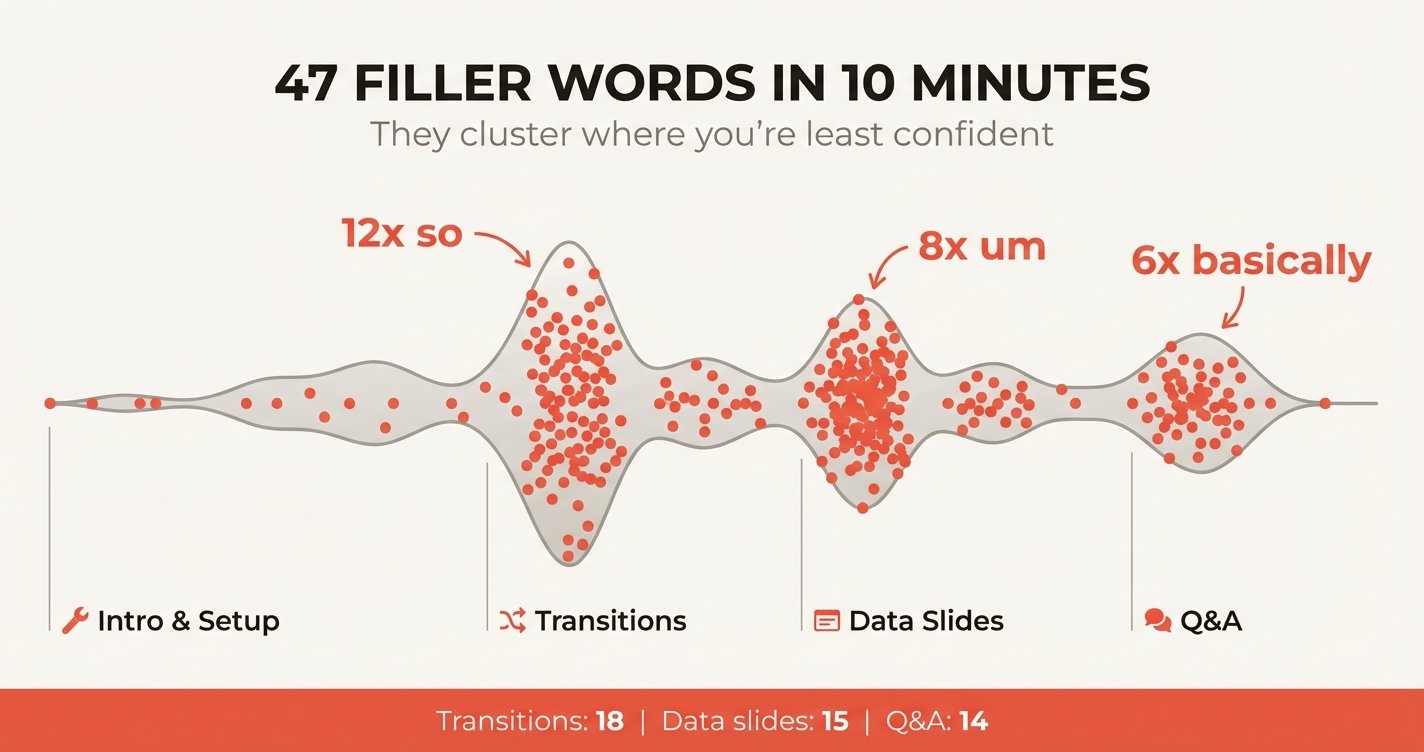
The average person uses 5-8 filler words per minute in conversation. That's fine at dinner. In a presentation, it's death by a thousand ums.
Here's why: every filler word is a micro-signal to your audience that says "I'm not sure what comes next." One or two is human. Forty-seven in a 10-minute presentation is a pattern. And your audience feels it before they consciously notice it.
The real cost of filler words
It's not that "um" is inherently bad. It's what it replaces: silence.
A pause is powerful. It says "I'm about to say something important." An "um" says "I'm searching." Same duration, opposite signal.
Watch any great speaker — Obama, Steve Jobs, Brené Brown. They pause constantly. Long, deliberate pauses. They never fill them. That's not natural talent. It's practice.
Where filler words cluster
Filler words aren't random. They cluster in predictable places:
- Transitions. Between slides, between topics, between ideas. "So, um, moving on to, uh, the next section..."
- Data slides. When you're about to state a number you're not confident about. "Our, um, customer acquisition cost is, like, around $180."
- Questions. When you're asked something you didn't prepare for. "That's a great question, so, um, basically..."
If you record yourself and timestamp every filler word, you'll see the pattern. They're not scattered — they're concentrated in the moments where you're least confident.
How to fix it
Step 1: Awareness. You can't fix what you can't see. Record a 5-minute presentation. Count every um, uh, like, so, basically, you know, right, actually. Write down the timestamp of each one.
Step 2: Find the triggers. Are they at transitions? During data? When you lose your place? The fix is different for each.
Step 3: Replace with silence. This is the hard part. When you feel an "um" coming, close your mouth. Just stop talking for one second. It feels like an eternity to you. To your audience, it sounds like confidence.
Step 4: Practice the transitions. If your filler words cluster at slide transitions, practice ONLY the transitions. "That's revenue. Now let me show you how we spend it." Clean. No filler. Practice it 10 times.
The 30-day challenge
Record yourself once a week. Count your filler words. Track the number. Most people go from 40+ per 10 minutes to under 10 within a month — just from the awareness of being recorded.
The camera is the best coach you'll ever have. It doesn't lie, it doesn't flatter, and it catches every single "um" you thought no one noticed.
More in Delivery And Presence
How to Reduce Filler Words in Presentations Without Sounding Over-Rehearsed
Learn how to reduce filler words in presentations with practical fixes for "um," "like," "so," and other verbal tics. Includes drills, pacing tactics, and a repeatable rehearsal method.
You're speaking too fast. Here's the exact WPM you should target.
Most presenters speak at 160-180 WPM. The optimal range is 120-140. Here's why the difference matters and how to fix it without sounding robotic.
Presentation Body Language Mistakes: 9 Habits That Quietly Undermine Credibility
Presentation body language mistakes are often subtle: disappearing eye contact, collapsed posture, nervous fidgeting, and low-energy transitions. Here is how to spot and fix them.
See yourself the way your audience sees you
Upload a presentation recording. Get AI coaching on delivery, slides, narrative, and audience reactions.
Try free preview