You're speaking too fast. Here's the exact WPM you should target.
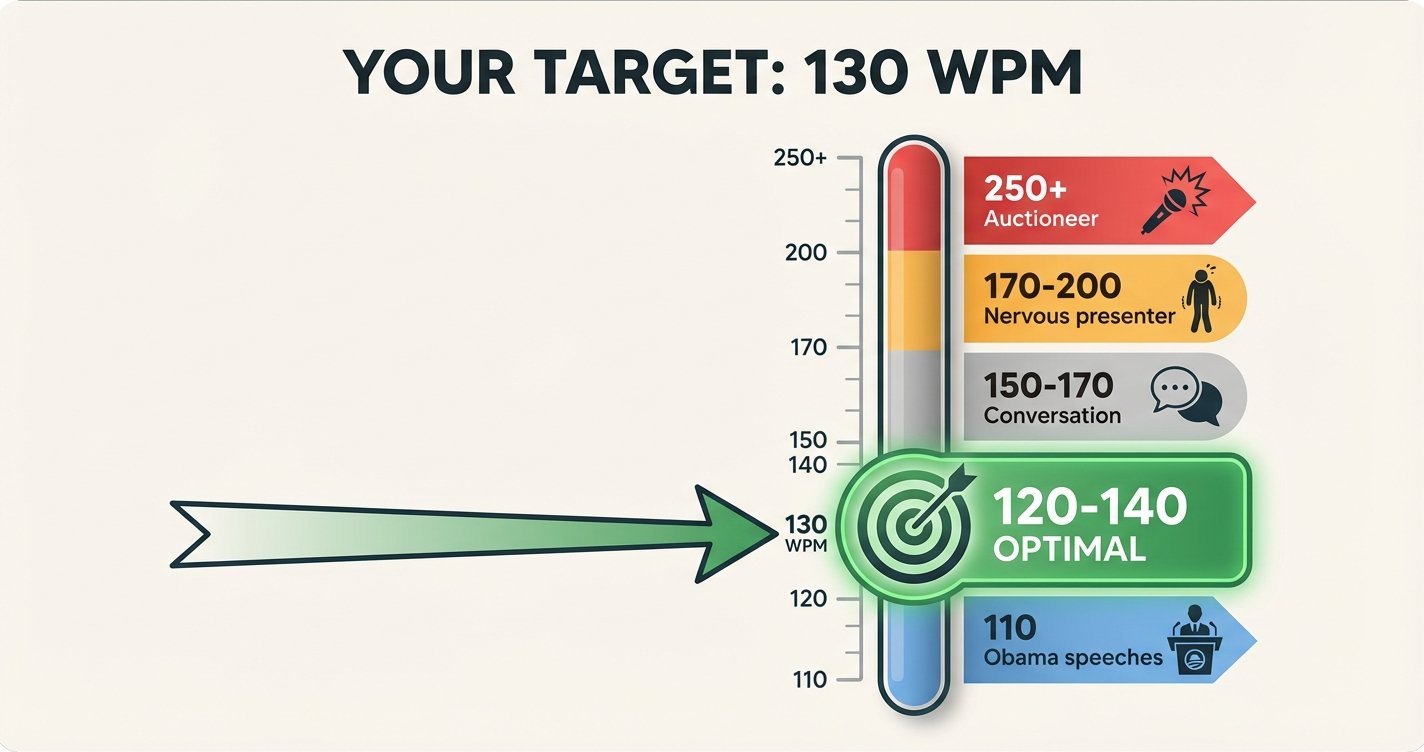
| Speed | WPM | Context | |-------|-----|---------| | Auctioneer | 250+ | Way too fast | | Nervous presenter | 170-200 | Most people are here | | Conversation | 150-170 | Normal but too fast for presenting | | Optimal | 120-140 | Target this | | Obama (speeches) | 110 | Deliberate authority |
You just finished presenting and someone said "that was great, maybe just slow down a bit." You nodded. Next time, you spoke at exactly the same speed.
The problem with "slow down" is that it's not specific enough to act on. You need a number.
The numbers
- Conversational speech: 150-170 WPM
- Typical presenter (nervous): 170-200 WPM
- Optimal presentation pace: 120-140 WPM
- TED talk average: 133 WPM
- Obama (speeches): 110 WPM
- Auctioneer: 250+ WPM
You're probably in the 160-180 range. You need to be at 130.
Why faster feels normal
When you present, adrenaline kicks in. Your heart rate increases. Your perception of time distorts. What feels like a normal pace to you is actually 20-30% faster than what your audience can comfortably process.
This is why recording yourself is so important. You genuinely don't feel like you're rushing. But when you watch the recording, you can hear it.
The section problem
You probably don't speak at one consistent speed. You have fast sections and slow sections. The pattern is predictable:
- Opening: Moderate (you rehearsed this)
- Middle sections: Fast (you're less confident, trying to get through it)
- Data slides: Very fast (you're nervous about the numbers)
- Closing: Moderate again (you rehearsed this too)
The middle 60% of your presentation is where pacing problems live. That's exactly the part you practice least.
How to actually slow down
"Just speak slower" doesn't work. Your brain defaults to its natural pace within 30 seconds. Here are tactics that actually work:
1. Pause after every slide transition. Full stop. One breath. Then start the next section. This alone cuts your effective WPM by 10-15%.
2. State numbers slowly. "$4.2 million in revenue" should take 3 seconds, not 1. Numbers are the moments your audience needs processing time. Rush them and they hear noise.
3. Drop your pitch. Literally lower your voice slightly. Speaking at a lower pitch naturally slows your pace. High-pitched + fast = nervous energy. Low-pitched + deliberate = authority.
4. Practice with a metronome. Set it to 130 BPM. Speak one word per beat for 60 seconds. This recalibrates your internal clock. It feels absurdly slow. It sounds perfect.
The recording test
Record yourself for 2 minutes. Use any word counter tool to count your words. Divide by 2. That's your WPM.
If you're above 150, you're too fast for a presentation context. The fix isn't global — find the 2-3 sections where you speed up most and practice only those at a deliberate pace.
Faster doesn't mean more confident. It means more nervous. The speakers you admire are the ones who take their time. Be one of them.
More in Delivery And Presence
You said 'um' 47 times. Here's why it matters.
Filler words aren't just a bad habit. They're a signal to your audience that you don't know what comes next. Here's how to eliminate them.
How to Reduce Filler Words in Presentations Without Sounding Over-Rehearsed
Learn how to reduce filler words in presentations with practical fixes for "um," "like," "so," and other verbal tics. Includes drills, pacing tactics, and a repeatable rehearsal method.
Presentation Body Language Mistakes: 9 Habits That Quietly Undermine Credibility
Presentation body language mistakes are often subtle: disappearing eye contact, collapsed posture, nervous fidgeting, and low-energy transitions. Here is how to spot and fix them.
See yourself the way your audience sees you
Upload a presentation recording. Get AI coaching on delivery, slides, narrative, and audience reactions.
Try free preview