How to rehearse a pitch deck (without wasting your investor's time)
You've spent three weeks on your pitch deck. The narrative is tight. The numbers are right. The design is clean. You've practiced it four times in front of your mirror.
Then you walk into the room, and within 90 seconds you're reading slide three, speaking at 180 words per minute, and you've already said "basically" six times.
The deck wasn't the problem. Your rehearsal was.
Most founders rehearse wrong
Here's what most founders do: they open the deck, click through it, and talk through each slide while looking at their laptop. They do this 3-5 times. They call it practice.
This is not rehearsal. This is reading your deck out loud while sitting down. It builds zero muscle memory for the actual moment: standing up, making eye contact, handling silence, dealing with a poker-faced investor who hasn't nodded in two minutes.
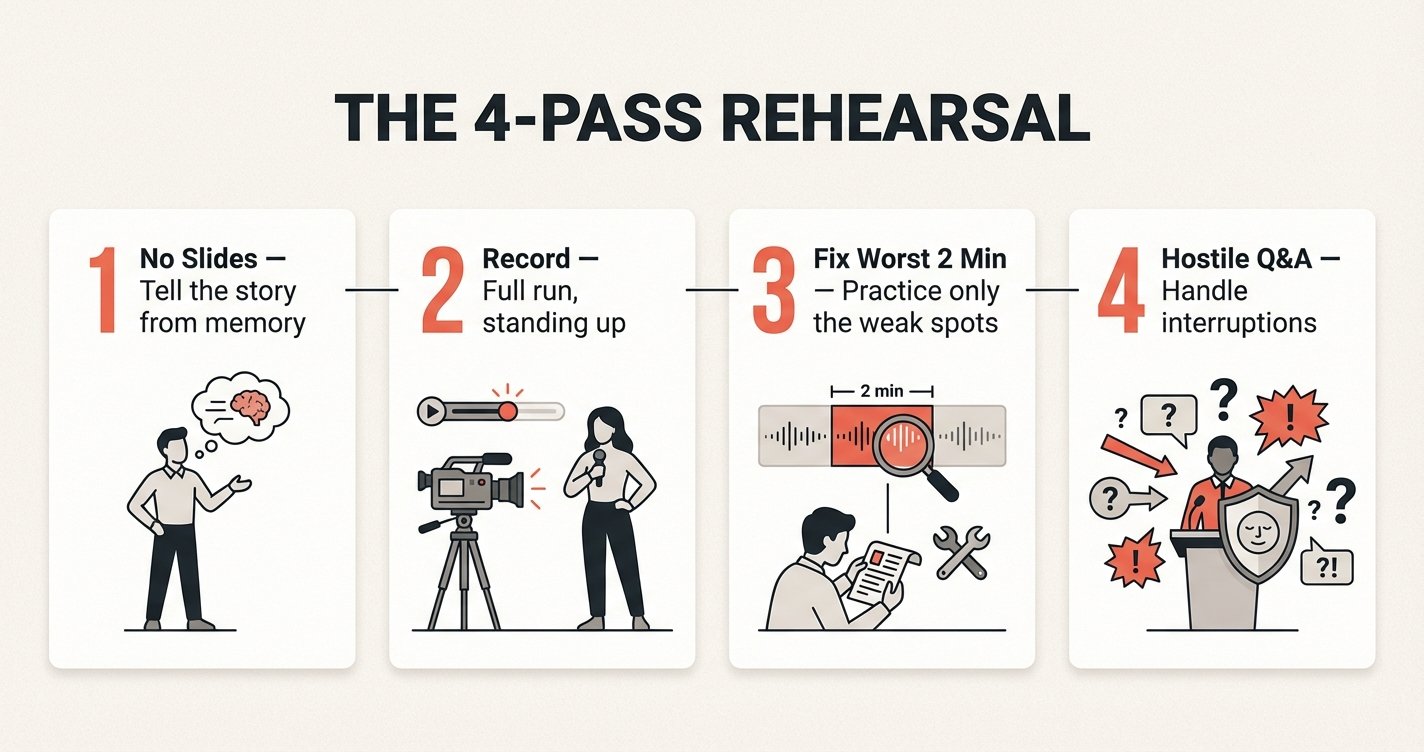
The 4-pass rehearsal framework
Pass 1: No slides. Just talk.
Close your laptop. Set a timer for 10 minutes. Tell the story of your company from memory. Problem, solution, traction, team, ask. No slides.
If you can't do this, you don't know your story — you know your deck. There's a difference.
Pass 2: Record yourself.
Open your deck. Present it like it's the real thing. Standing up. Looking at camera. Record the whole thing.
Watch it back. You'll hate it. That's the point. Note three things:
- Where do you speed up? (You're nervous there.)
- Where do you look at the screen? (Your slides have too many words.)
- Where do you lose energy? (You don't believe in that section.)
Pass 3: Fix the worst 2 minutes.
Don't re-rehearse the whole thing. Find the 2 minutes that were worst in your recording. Usually it's the market size slide, the financial projections, or the ask.
Practice ONLY those 2 minutes. Ten times. Until you can deliver them without looking at the slide, without speeding up, without filler words.
Pass 4: Hostile audience.
Get someone to interrupt you. Have them ask "Why should I care?" after your second slide. Have them say "Your competitor does the same thing" in the middle of your product demo. Have them check their phone.
If you can maintain composure through interruptions, the actual pitch will feel easy.
The numbers that matter
In our analysis of pitch presentations, the patterns are consistent:
- Pacing: Founders average 170 WPM on pitch decks. Optimal is 130-140. You're almost certainly too fast.
- Filler words: Average of 4.2 per minute. Top-performing pitches have under 1.
- Eye contact: Most founders look at their slides 40% of the time. Investors fund people, not decks.
- The ask: 73% of founders rush through the amount. The single most important number in your deck gets the least confident delivery.
The 24-hour rule
Rehearse your pitch at least 24 hours before the meeting. Not the morning of. Not in the Uber on the way there. Twenty-four hours.
Your brain needs sleep to consolidate the practice. The version of you that rehearsed last night is dramatically better than the version rehearsing in the elevator.
One more thing
The best founders don't rehearse until the pitch is perfect. They rehearse until the pitch is theirs. There's a difference between a polished presentation and an authentic one. Investors can tell. Practice enough that you stop performing and start talking.
More in Pitch Deck And Fundraising
How to Practice a Pitch Deck Before an Investor Meeting: A Rehearsal Plan for Founders
Practicing a pitch deck is not the same as reading slides aloud. Use this founder-focused rehearsal plan to sharpen narrative, pacing, proof, and the ask before an investor meeting.
5 pitch delivery mistakes VCs notice in the first 60 seconds
VCs make a snap judgment in the first minute of your pitch. These are the 5 delivery mistakes that trigger a 'no' before you even get to your product.
How to Deliver an Investor Update Presentation Without Sounding Defensive
Investor update presentations go wrong when founders rush the numbers, over-explain weak spots, or bury the real story. Here is a rehearsal framework that fixes that.
See yourself the way your audience sees you
Upload a presentation recording. Get AI coaching on delivery, slides, narrative, and audience reactions.
Try free preview