5 pitch delivery mistakes VCs notice in the first 60 seconds
A VC partner told me: "I know within 60 seconds whether this is a real company or a science project. It's not the idea. It's how they talk about it."
Your pitch deck is fine. Your market is big enough. Your traction is real. But if your delivery signals "uncertain" in the first minute, the rest of the meeting is uphill.
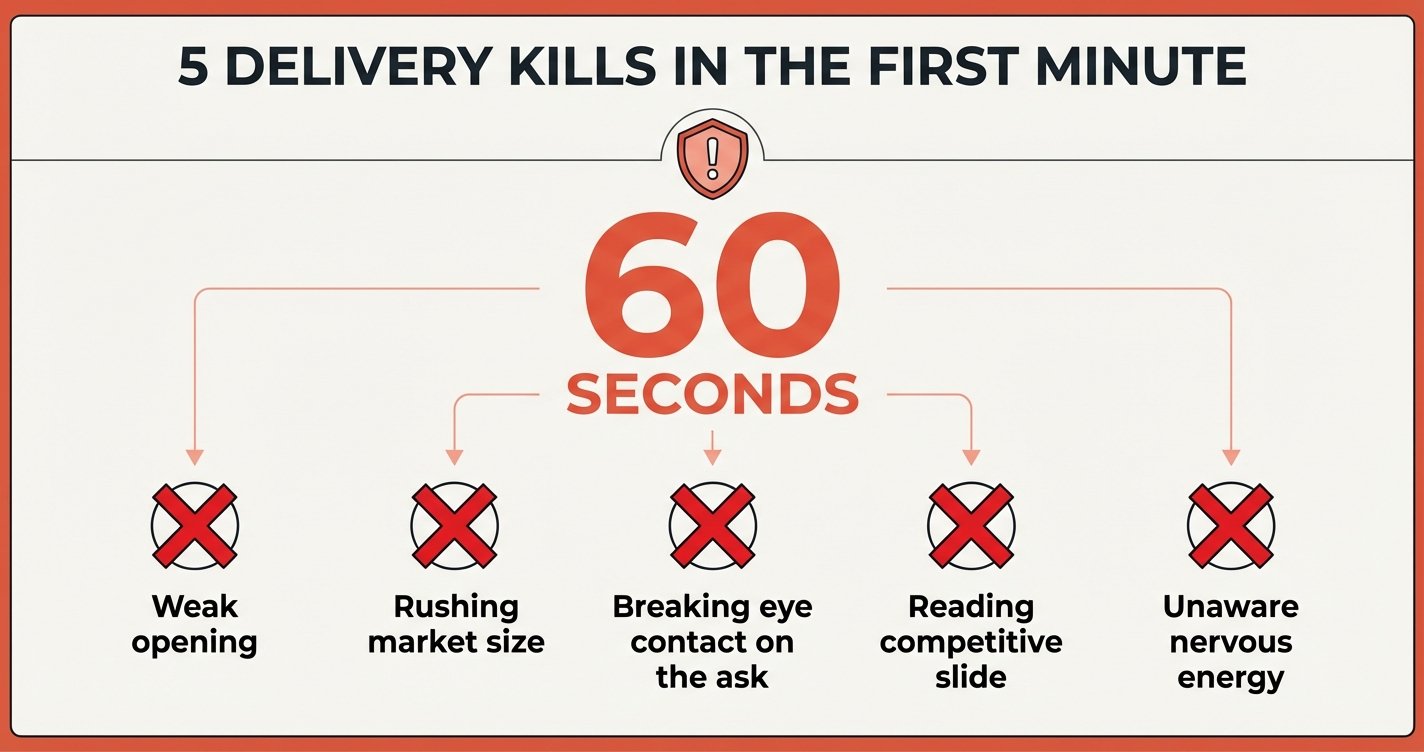
Here are the 5 delivery mistakes that trigger a "no" before you've shown your product:
1. Starting with "So, a little bit about us..."
Weak openings kill pitches. "So" is a filler word. "A little bit" is hedging. "About us" is self-centered. You've used 7 words and said nothing.
Instead: Start with the problem. Start with a number. Start with a story. "Last year, enterprise sales teams lost $4.7 billion to bad demos. We fix that."
The opening sets the frame. If you frame yourself as "let me tell you about my company," the VC frames you as one of eight pitches today. If you frame the problem as urgent and expensive, they frame you as someone who gets it.
2. Rushing through the market size
Every pitch has a market size slide. Most founders speed through it: "The TAM is $50 billion, um, based on [source], so basically it's a huge market, moving on..."
This is the slide investors care about most, and you're nervous because you know the number might get challenged. So you rush.
Instead: State the number slowly. Pause. Explain ONE layer of how you got there. "The spend on sales enablement tools is $12 billion. We're going after the demo-specific portion — that's $3.2 billion growing at 25% year over year."
Slow, specific, confident. The VC is watching whether you own this number or you're hoping they won't question it.
3. Breaking eye contact during the ask
The ask — how much you're raising and what you'll use it for — is the moment of maximum vulnerability. Most founders look at their slide, drop their voice, and rush: "So we're raising 2 million on a post-money of 15, um, and that'll get us to our next milestone."
The VC sees: this person isn't confident in their own valuation.
Instead: This is the one line in your pitch you should memorize cold. Look the investor in the eye. Speak slowly. "We're raising $2 million at $15 million post. That gets us to $2M ARR, which puts us in position for a Series A in 14 months."
Conviction in the ask is non-negotiable.
4. Reading your competitive landscape slide
The competitive landscape slide — the 2x2 matrix or the feature comparison table — is the most-read slide in every pitch. And it's the slide founders read from most often.
The irony: this is the slide where you should be most conversational. You should know your competitors better than any slide can convey. Instead, you're squinting at the matrix saying "so as you can see, we're in the upper right..."
Instead: Don't read the matrix. Tell the story. "There are two serious competitors. [Name] has the enterprise market but their product is 5 years old and built for a different era. [Name] raised $30M but their retention is publicly known to be under 60%. We're the only one building [specific differentiator]."
That's not reading a slide. That's demonstrating market intelligence.
5. Nervous energy without awareness
Pacing, chair swiveling, pen clicking, hand wringing, voice getting higher as you go — these are all signals of nervousness that you don't feel but your audience absolutely sees.
VCs meet with founders every day. They're calibrated to these signals the way a poker player reads tells. They're not consciously thinking "this person is nervous." They're feeling "I'm not confident this team can close enterprise deals."
The only fix: Record yourself. Watch it. See what they see. You cannot fix what you cannot see.
Every one of these mistakes is invisible to you during the pitch. You feel like you're doing fine. The recording says otherwise. That's why the most prepared founders aren't the ones who rehearse the most — they're the ones who watch their rehearsals back.
More in Pitch Deck And Fundraising
How to Practice a Pitch Deck Before an Investor Meeting: A Rehearsal Plan for Founders
Practicing a pitch deck is not the same as reading slides aloud. Use this founder-focused rehearsal plan to sharpen narrative, pacing, proof, and the ask before an investor meeting.
How to rehearse a pitch deck (without wasting your investor's time)
Most founders practice their pitch wrong. They rehearse the slides, not the delivery. Here's a rehearsal framework that actually works.
How to stop reading your slides (and what to do instead)
You know you're reading your slides. Your audience knows too. Here's how to break the habit using a technique most presentation coaches won't tell you.
See yourself the way your audience sees you
Upload a presentation recording. Get AI coaching on delivery, slides, narrative, and audience reactions.
Try free preview