How to prepare for a thesis defense (from someone who almost failed one)
You spent 2 years on the research. You have 247 slides. You know every data point, every methodology choice, every limitation. You're ready.
Then your committee member asks "why didn't you use method X instead?" and you freeze for 8 seconds before mumbling something about sample size.
The defense isn't about what you know. It's about how you handle what you don't.
The mistake everyone makes
Most PhD candidates prepare for a thesis defense by rehearsing their presentation slides. They go through the deck 5-10 times, refining transitions, practicing their timing.
This is preparing for the wrong thing. The presentation is 20-30 minutes. The Q&A is 60-90 minutes. You're practicing for the appetizer and skipping the main course.
Prepare for the 10 hardest questions
Before your defense, write down the 10 questions you're most afraid of. Not the ones you can answer easily — the ones that make your stomach drop.
- "Why is your sample size sufficient?"
- "How do you address the confounding variable of X?"
- "Your literature review doesn't mention [important paper]. Why?"
- "What would you do differently if you started over?"
- "How does this contribute to the field beyond what [author] already showed?"
Now practice answering each one out loud. Not in your head — out loud. Record yourself. Listen back. Is the answer structured? Is it confident? Or is it a rambling 3-minute response that never quite gets to the point?
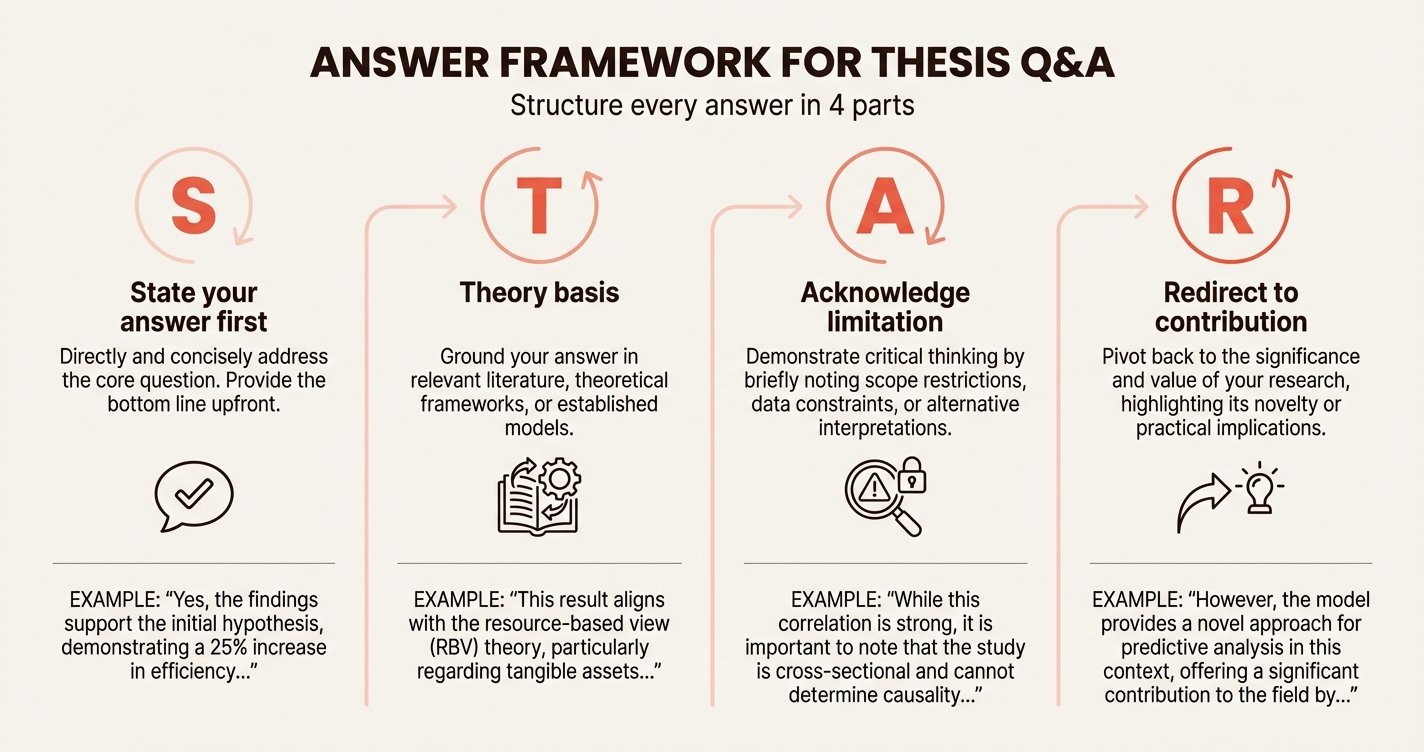
The STAR method for academic Q&A
Structure every answer:
- State your answer in one sentence first
- Theory — what's the theoretical basis for your choice
- Acknowledge the limitation — showing you thought about it
- Redirect to your contribution — what your work adds despite the limitation
Example: "Why didn't you use a longitudinal design?"
"Cross-sectional was the right choice for this stage of the research. The theoretical framework from [author] suggests that the variables I'm measuring are stable over the timeframe in question. I acknowledge that a longitudinal design would strengthen causal claims, and I've identified that as a next step in chapter 6. What this cross-sectional data does give us is the first evidence that [your contribution]."
Structured. Confident. Honest about limitations. Redirects to your value.
The delivery matters more than you think
Your committee knows you know the content. They've read your thesis. The defense is about whether you can communicate it under pressure. Can you:
- Explain your methodology to a non-specialist in 60 seconds?
- Handle an interruption without losing your train of thought?
- Admit "I don't know, but here's how I'd find out" without sounding uncertain?
- Stay calm when someone challenges your fundamental assumption?
These are delivery skills, not knowledge skills. And they can be practiced.
The recording trick
Record yourself answering your 10 hardest questions. Watch back. You'll notice:
- You rush through answers when you're uncertain
- You use hedging language: "I think," "sort of," "kind of"
- You break eye contact when you're not confident in your answer
- Your answers are 2x longer than they need to be
Now re-record. Same questions. Shorter answers. More pauses. Stronger opening sentences. Compare the two recordings side by side.
The difference between a candidate who "passed" and one who "impressed" is almost entirely delivery, not content.
More in Academic Presentations
Thesis Defense Rehearsal Checklist: What to Practice Before You Face the Committee
Use this thesis defense rehearsal checklist to prepare your talk, tighten your methodology explanation, and avoid the pacing and clarity mistakes committees notice immediately.
Presentation anxiety is a preparation problem, not a confidence problem
You don't have stage fright. You have under-preparation disguised as anxiety. Here's how to fix the root cause instead of treating the symptoms.
How to Rehearse a Presentation by Yourself: A 7-Step System That Actually Works
Practicing a presentation alone does work if you follow a repeatable system. Use this 7-step solo rehearsal workflow to improve pacing, confidence, and clarity before a high-stakes talk.
See yourself the way your audience sees you
Upload a presentation recording. Get AI coaching on delivery, slides, narrative, and audience reactions.
Try free preview